
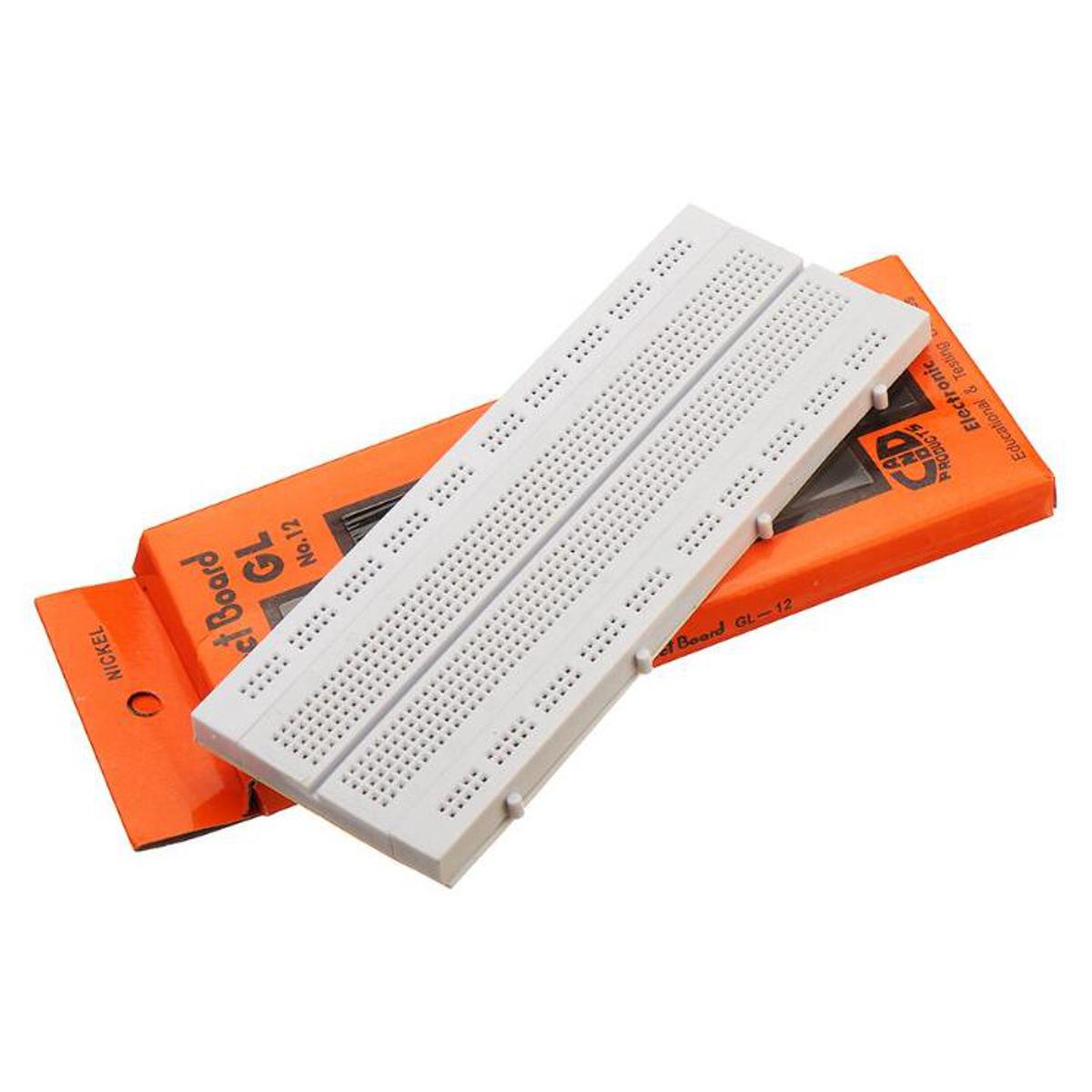
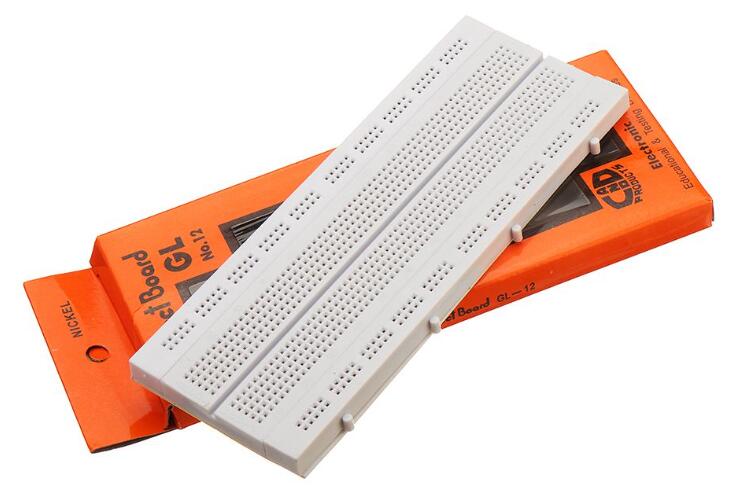
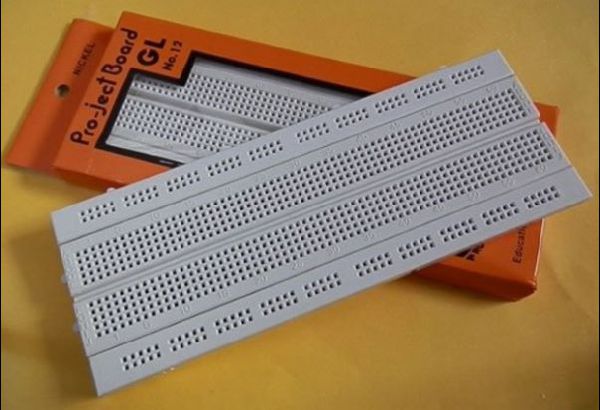
- 🆔 Model Identification: The board is clearly identified on the packaging as Model "GL No. 12", a standard designation for this specific size of prototyping board.
- 🔌 High Capacity: This is a full-size breadboard, typically featuring 830 to 840 tie points, allowing for medium-to-complex circuit designs.
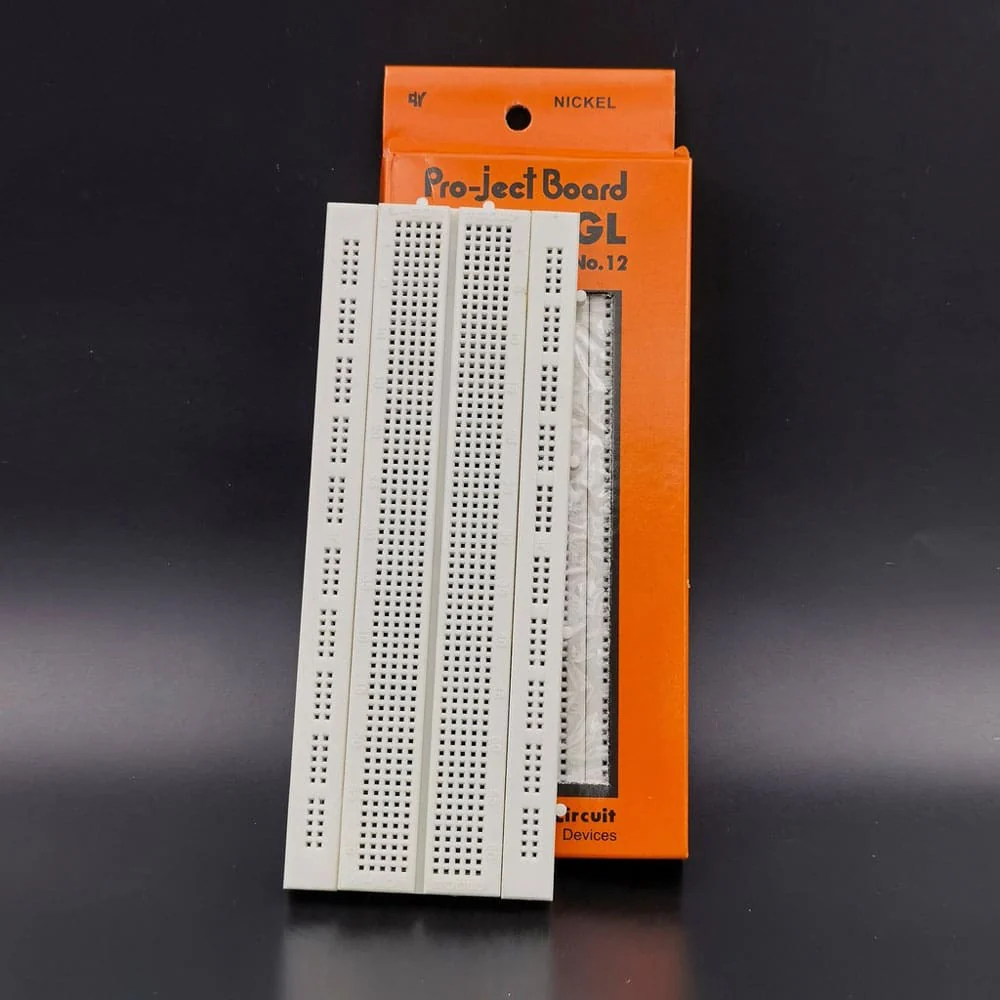
- 💎 Contact Material: The packaging flap has a specific marker for "NICKEL", indicating the internal spring clips are nickel-plated phosphor bronze rather than gold or silver.
- 🏗️ Interlocking Design: The board features dovetail tabs (visible nubs) along the sides, allowing you to physically lock multiple boards together to create a larger workspace.
- ⚡ Dual Power Rails: It includes distinct vertical distribution strips on the far left and right edges, used specifically for easy access to power ($+$) and ground ($-$).
- 🧩 IC Friendly: There is a central divider (ravine) running down the middle of the board, sized perfectly to straddle Integrated Circuits (DIP chips) so pins don't short-circuit.
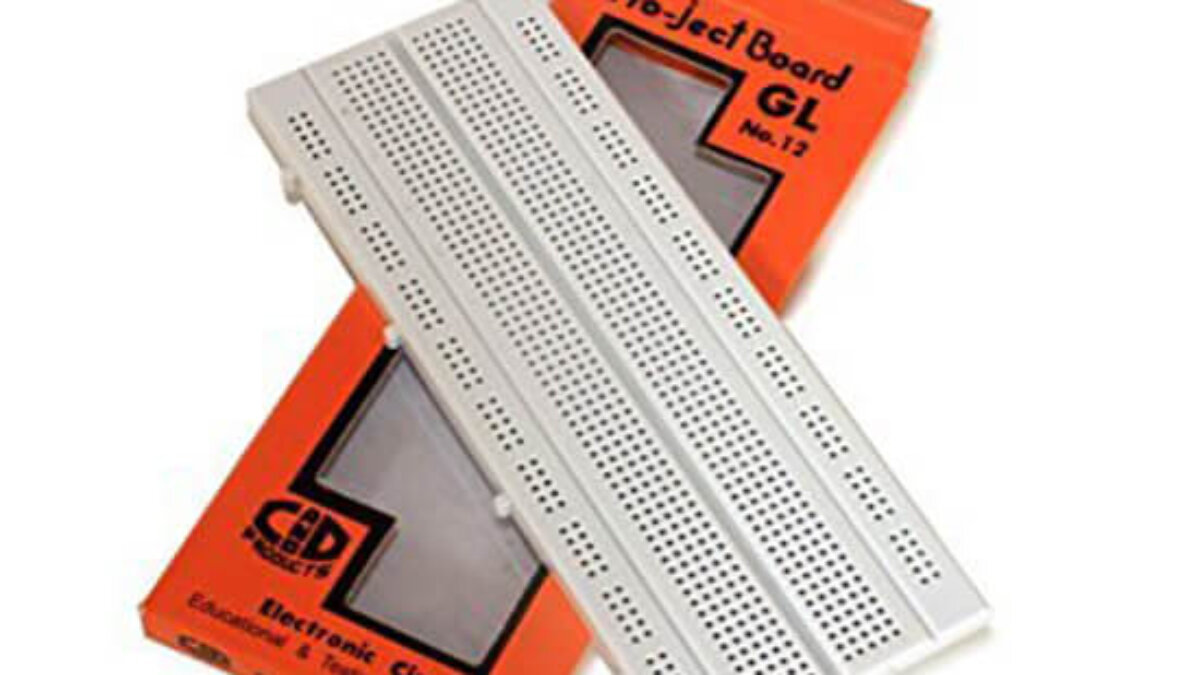
- 📦 Distinct Packaging: The product comes in a vibrant orange and black box branded with "C&D PRODUCTS" and "Electronic & Testing."
- ⚪ Durable Build: The housing is made of standard white ABS plastic, which is electrically insulating and heat resistant.
- 🔄 Reusable: As a "solderless" board, components can be inserted and removed repeatedly without damage, making it ideal for rapid prototyping.
- 📏 Standard Spacing: The holes utilize a standard 0.1-inch (2.54mm) pitch, making it compatible with almost all through-hole electronic components.

Login
Purchase products from our website and enjoy Free Shipping.

Poduct Detail
ARDUINO GL 12 840 Hole Solderless Breadboard Experimental PCB Breadboard 830 Tie Point Universal for Arduino Electronics Prototyping Projects in Pakistan
KHREED.PK
Rs. 500
In StockSKU:
Categories & Tags: Toys & Games, Learning & Education, Imported, Pakistan, Discount, High Quality
Share:
Features:
🆔 Model Identification: The board is clearly identified on the packaging as Model "GL No. 12", a standard designation for this specific size of prototyping board.🔌 High Capacity: This is a full-size breadboard, typically featuring 830 to 840 tie points, allowing for medium-to-complex circuit designs.💎 Contact Material: The packaging flap has a specific marker for "NICKEL", indicating the internal spring clips are nickel-plated phosphor bronze rather than gold or silver.🏗️ Interlocking Design: The board features dovetail tabs (visible nubs) along the sides, allowing you to physically lock multiple boards together to create a larger workspace.⚡ Dual Power Rails: It includes distinct vertical distribution strips on the far left and right edges, used specifically for easy access to power ($+$) and ground ($-$).🧩 IC Friendly: There is a central divider (ravine) running down the middle of the board, sized perfectly to straddle Integrated Circuits (DIP chips) so pins don't short-circuit.📦 Distinct Packaging: The product comes in a vibrant orange and black box branded with "C&D PRODUCTS" and "Electronic & Testing."⚪ Durable Build: The housing is made of standard white ABS plastic, which is electrically insulating and heat resistant.🔄 Reusable: As a "solderless" board, components can be inserted and removed repeatedly without damage, making it ideal for rapid prototyping.📏 Standard Spacing: The holes utilize a standard 0.1-inch (2.54mm) pitch, making it compatible with almost all through-hole electronic components.
Description:
The Main Object: Solderless Breadboard
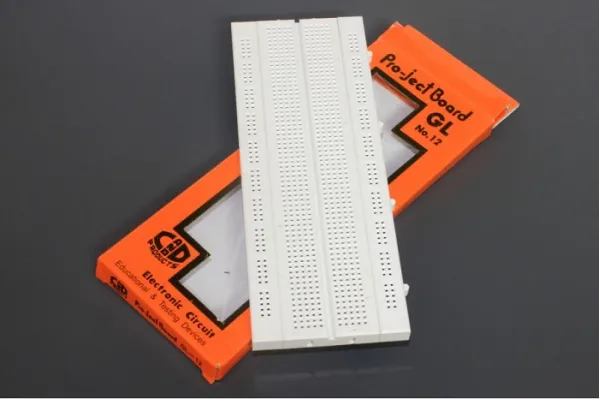
- Appearance: The primary object is a standard, full-size solderless breadboard made of white ABS plastic. It is rectangular in shape.
- Layout:
- Terminal Strips: The central area consists of two columns of 5-hole rows (tie-points). These are separated by a central divider (or ravine/notch) running down the middle, which is standard for placing Integrated Circuits (ICs) so their pins do not short.
- Distribution Strips (Power Rails): On both the far left and far right edges, there are two vertical columns of holes. These are typically used for power ($+$) and ground ($-$) distribution.
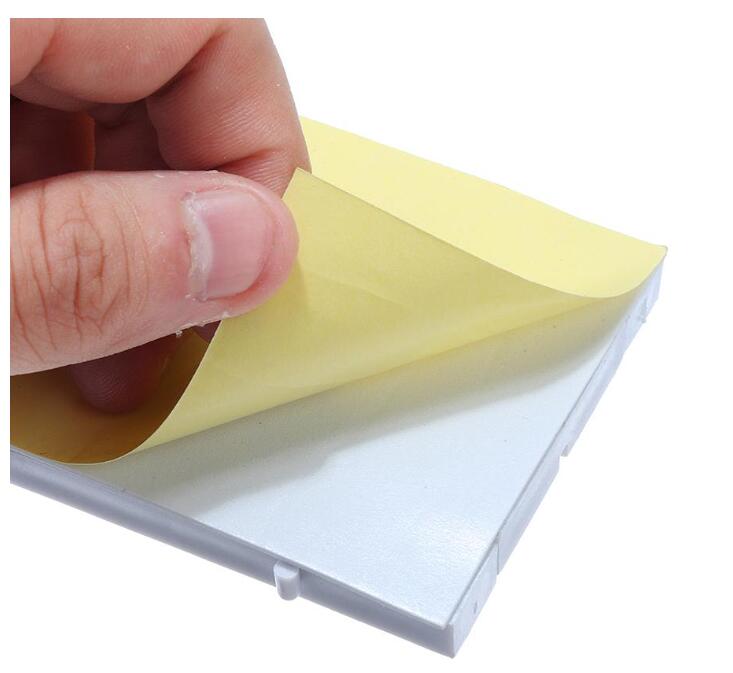
- Modularity: Along the long edges of the board, there are protruding plastic tabs (dovetail joints) and corresponding slots. These allow multiple breadboards to be locked together to create a larger prototyping surface.
- Orientation: The board is resting diagonally across its packaging box.
The Packaging: Box Details
- Color: The box is a vibrant orange with black and white text.
- Text & Markings:
- Model Number: The text "GL No. 12" is printed boldly in black.
- Product Name: Partially obscured text reads "ct Board", implying "Project Board" or "Contact Board."
- Material Indicator: On the left flap, there is a circle marked "NICKEL" which is punched out or marked, indicating the internal metal spring clips are nickel-plated (as opposed to gold or silver).
- Branding: A logo on the right side reads "C&D PRODUCTS".
- Subtitle: Text on the right reads "Electronic & Testing..." suggesting it is for educational or lab use.
Technical Specification Table
Based on the visual identification of the "GL No. 12" model and standard breadboard architecture, here are the likely specifications:
Feature | Specification |
Product Type | Solderless Breadboard / Project Board |
Model Number | GL-12 |
Total Tie Points | 840 points (Estimated: 128 groups of 5, plus 8 power rails of 25) |
Dimensions | Approx. 175mm x 67mm x 8mm |
Material | White ABS Plastic housing |
Contact Material | Nickel-plated spring clips (indicated on box) |
Wire Compatibility | Suitable for 20-29 AWG solid core wire |
Voltage/Current Rating | Typically up to 300V / 3-5A (Standard for this type) |
Mounting | Interlocking tabs for side-by-side expansion |
Functional Overview
- ⚡ Prototyping: This tool is used by engineers, students, and hobbyists to build temporary electronic circuits without soldering.
- Power Distribution: The side rails (distribution strips) usually carry the voltage and ground to easily power components placed in the center.
- DIP Support: The center groove is specifically sized to bridge the legs of Dual Inline Package (DIP) chips, keeping the two sides of the chip electrically isolated.

CONTACT INFORMATION
CALL
+92 318 04500 11
FIND US
Lahore Pakistan